

Last Updated: November 1, 2026
Quick Summary
The essential golf accessories for beginners are a short starter kit: golf tees in a mix of lengths, a ball marker, a divot repair tool, a golf towel, a golf glove and a scorecard with a pencil. Most of these are inexpensive, and they prevent the most common on-course stoppages.
- Pack golf tees in a mix of lengths for driver and irons.
- A ball marker lets you lift and replace your ball on the green.
- A divot repair tool keeps putting surfaces smooth for the group.
- Keep two spare golf balls in the bag.
- Skip a rangefinder until your paced yardages start costing strokes.
Table of Contents
- Essential Golf Accessories for Beginners: What to Buy First
- Golf Accessories Checklist: The Core Items Every New Golfer Needs
- Beginner Golf Bag Essentials and How to Pack Them
- Choosing a Golf Glove for Beginners
- Tees, Ball Markers and Divot Tools: Small Items That Matter
- Golf Towels and Club Protection for Beginners
- Golf Rangefinder for Beginners: Do You Need One?
- What Beginner Golfers Can Skip and How to Build a Budget Starter Kit
- Your First-Round Packing List and Next Step at ReadyGOLF
- Frequently Asked Questions
Essential Golf Accessories for Beginners: What to Buy First
Starting out in golf means facing a shop full of gadgets, and most of them can wait. The essential golf accessories for beginners are a short list: a few tees, a ball marker, a divot tool, a towel and a good glove. New golfers often spend heavily on extras before they have a bag full of basics, so this guide puts the core items first and shows what can wait.
The practical rule is simple. Buy the items you will use on every round, then add the rest once you know how you play. A new golfer who loses two tees and forgets a ball marker on the first hole has learned more than any guide can teach.
Golf Accessories Checklist: The Core Items Every New Golfer Needs
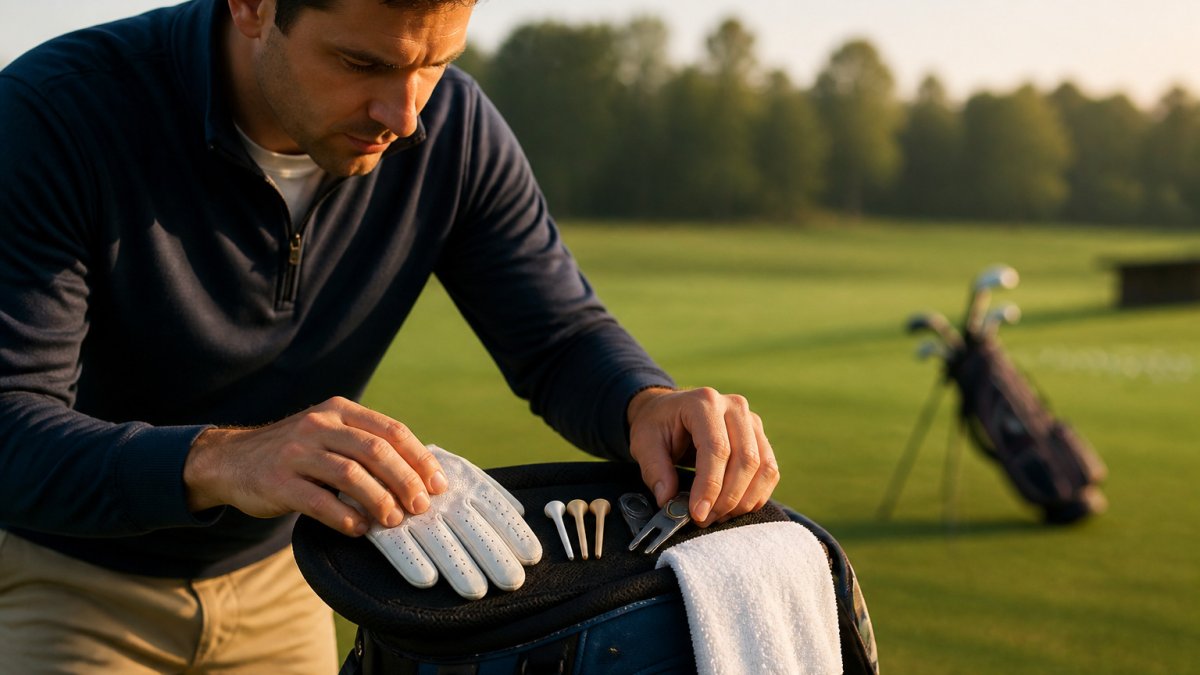
Golf accessories are the small items that keep a round moving: tees, ball markers, a divot repair tool, a towel and a glove. Treat this list as your starting kit and expand from there.
- Golf tees (a mix of lengths for driver and irons)
- Ball marker
- Divot repair tool
- Golf towel for cleaning clubs and balls
- Golf glove matched to your grip
- Scorecard and pencil
- Spare golf balls
Most of these cost little, but they prevent the most common on-course stoppages. A dirty club face or a missing tee can slow your rhythm more than a poor swing does.
!A beginner golfer laying out a glove, tees, a divot tool and a towel on a golf bag at a practice range in soft morning light
The core items below cover what most beginners need for a first round, drawn from the checklist above.
| Item | Purpose | Note |
|---|---|---|
| Golf tees | Set ball height for each club | Mix of lengths for driver and irons |
| Ball marker | Lift and replace ball on the green | Keep it in a handy pocket |
| Divot repair tool | Repair damage on the green | Helps keep putting surfaces smooth |
| Golf towel | Clean clubs and balls | Keeps contact clean and shots easier to read |
| Golf glove | Keep a firm, consistent grip | Match fit to your grip |
| Scorecard and pencil | Track your score | Pack before the round |
| Spare golf balls | Replace lost or damaged balls | Keep two in the bag |
Beginner Golf Bag Essentials and How to Pack Them
Packing a bag well matters more than buying a fancy one. Keep the items you reach for most in the outer pockets and the items you rarely need deep inside. A common mistake is loading the bag with spare gear that never leaves the trunk.
Pack in this order: consumables near the top, tools in the middle pockets, and anything you might need in a hurry clipped to the outside. Your towel should hang where it can reach a damp club without digging.
Watch out: a loose divot tool rattling against your clubs can dent a club head over a season. Keep it in a dedicated pocket.
Choosing a Golf Glove for Beginners
A glove helps most golfers keep a firm, consistent grip, especially when hands get sweaty or the grip is worn. Most beginners do well with a single glove on the lead hand, the left hand for a right-handed golfer. Choose a fit that is snug without restricting your fingers, and replace it when the grip surface wears smooth.
Glove sizing varies by brand, so measure your hand rather than guessing from a label. Gloves wear out faster in hot, wet conditions, so keep a spare in the bag once you play regularly.
Tees, Ball Markers and Divot Tools: Small Items That Matter
Tees, ball markers and divot tools are cheap, easy to lose and surprisingly useful. Tees let you set the ball at the right height for each club. A ball marker lets you lift your ball on the green, clean it and replace it exactly where it was. If you would rather keep one close at hand, the Bonjoc Ball Marker Pendant Necklace shows a wearable option. A divot tool repairs the damage your ball leaves on the green, which keeps putting surfaces smooth for the whole group.
If you want to keep these items within reach, The Tee Clip® is a USA-made magnetic golf tee holder priced at $24.99. It holds two standard tees and also works as a ball marker, alignment tool and divot repair tool, clipping to the brim of your hat.
For a more distinctive option, the Sunfish Divot Tool in the Totem Pole design is priced at $30.00. It is made from durable metal, has a pocket-friendly size and is available in copper, brass or black chrome.
Golf Towels and Club Protection for Beginners
A towel keeps clubs and balls clean, which improves contact and makes each shot easier to read. Choose a towel with a center loop so it attaches to your bag and stays within reach.
The Bones Waffle Golf Towel by ReadyGOLF is priced at $24.95. It is made of microfiber with a traditional waffle weave, measures 16" x 34", is machine washable and has a center loop for secure bag attachment. Golfers who want their gear to stand out may like its skeleton-themed design. Keeping your equipment clean and organized is just as vital as the strategy behind packing for golf when preparing for a multi-day trip.
Club protection is the other half of this category. Headcovers keep driver and fairway wood faces from knocking together in the bag. If you play in wet weather, a towel and a dry pocket for your scorecard will save you more trouble than an extra club.
Golfers who want a scorecard holder that matches their style can browse the Sunfish scorecard and yardage book holders. The Astronaut version is priced at $55.00 and the Fly the W version at $55.00, both with five elastic bands to hold the scorecard, yardage book, hole location sheet and pencil.
Golf Rangefinder for Beginners: Do You Need One?
Short answer: probably not yet, but it is worth understanding what a rangefinder does so you can decide when it earns a place in your bag.
How a rangefinder actually works
A laser rangefinder fires an invisible beam at a target, usually the flagstick or a hazard, and times the reflection to calculate distance. Most models show yards to the flag, and many add slope-adjusted distance, which accounts for uphill and downhill shots. That slope feature is the one to watch: it is helpful in casual play but restricted in many competitions under the local rule, so check before you enter an event.
Bones Waffle Golf Towel by ReadyGOLF →
When a beginner should buy one
A rangefinder becomes useful when three things are true:
- You hit consistent distances. If your 7-iron varies by 25 yards, precise yardage does not help yet.
- You play courses with unmarked hazards. Courses with sparse sprinkler heads and few yardage markers reward a device.
- You are starting to score. Once you care about club selection on approach shots, a rangefinder earns its keep.
Until then, learn to pace off yardage from course markers, sprinkler heads, and your own steps. That skill builds judgment a device cannot give you, and it costs nothing.
What to look for if you do buy
- Magnification: 6x is standard and enough for most golfers; 7x helps on long courses.
- Slope mode: useful for practice, but confirm it can be switched off for competition.
- Flag lock: a vibration or visual confirmation when the beam hits the pin, which prevents reading a tree behind the green.
- Water resistance: worth having if you play in dew or light rain.
- Battery type: most use CR2 batteries; keep a spare in the bag.
The cheaper alternative
A GPS watch or a phone app gives front, middle, and back distances without aiming at a target. Many beginners find a GPS app sufficient for a season and upgrade to a rangefinder only when they want precise pin distances. Either way, the accessory is a later purchase, not a first-round one.
What Beginner Golfers Can Skip and How to Build a Budget Starter Kit
Most beginner guides list everything you could buy. Fewer tell you what to leave on the shelf. The fastest way to waste money in your first season is to buy gear that solves a problem you do not have yet. Here is how to separate must-buys from upgrades, with realistic budget tiers and a clear skip list.
The three-tier starter kit
This tier covers every item you will touch on a normal round. If you buy nothing else, you can play a full 18 without borrowing from a playing partner.
Tier 2 is where most golfers land after five to ten rounds, once they know they are sticking with the game.
What beginners can skip (for now)
- A rangefinder. Skip until your paced yardages start costing you strokes. See the rangefinder section below.
- A second towel. One good microfiber towel is enough until it is dirty every round.
- Rain gear. Skip until you actually have a tee time in the forecast. Borrow or buy a cheap poncho for the first wet round.
- Specialty training aids. Most beginners improve faster with range time than with a gadget that promises a fix.
- A premium bag. A basic stand bag carries the same essentials; upgrade once the straps or pockets actually fail.
- Custom headcovers. Fun, but they protect nothing a stock headcover does not.
- Ball retriever. Useful for water hazards, but not a first-season priority.
Rules and etiquette for the accessories you do carry
Accessories are also etiquette tools. A few practical basics go a long way with playing partners and course staff:
-
Repair your pitch mark on the green with a divot tool, then press the turf flat with your putter. Repairing one you did not make is a common courtesy.
-
Replace divots in the fairway with the displaced turf, or use the sand-and-seed mix many courses provide.
-
Use a ball marker to lift and clean your ball on the green, then replace it exactly where it sat. Do not mark in another player's line.
-
Keep tools in your bag, not on the green. A divot tool left on the fringe is easy to lose and slows the group behind you.
-
Rake bunkers after your shot and leave the rake where the course asks.
None of this requires expensive gear. It requires carrying the small items you already bought and using them every hole.
A note on buying used
Tees, towels, gloves, and divot tools are cheap enough that used rarely makes sense. Bags, push carts, and rangefinders are different: a used rangefinder from a reputable seller can save real money, but check that it still measures slope and that the battery door seals. For balls, used is fine for practice but avoid water-logged balls for scoring rounds.
Your First-Round Packing List and Next Step at ReadyGOLF
Before your first round, check the list: tees, ball marker, divot tool, towel, glove, scorecard, pencil and two spare balls. Pack the night before so nothing gets left in the car.
Once you have the basics, explore the full range of golf accessories at ReadyGOLF and build your kit one item at a time. Start with the items you will use on every round, and add personality pieces as you go.
Frequently Asked Questions
What accessories does a beginner golfer need?
A beginner needs a few core items: a golf glove for the lead hand, a supply of tees, a ball marker, a divot repair tool, and a towel for cleaning clubs and balls. These cover most situations on the course. Add a headcover for woods and a scorecard holder if you keep score. Everything else can wait until you know which gaps your game has. Buying the essentials first keeps the starting cost low and lets you spend on the items you actually use.
What should a beginner golfer carry in their golf bag?
Keep the bag focused. Carry your clubs, a few spare golf balls, extra tees, a glove, a towel, a ball marker, and a divot tool. Add rain gear and sunscreen if the forecast calls for it. Many new players overpack, which adds weight and makes the bag harder to manage on walks. A simple packing list checked the night before a round prevents most forgotten items.
Do beginner golfers need a golf rangefinder?
Not necessarily. A rangefinder helps with distance judgment, but many beginners get value from learning yardages by pacing off distances or using course yardage markers first. If you want one, a basic model is enough for most new players, and it can be a useful upgrade once you are playing regularly. Treat it as an optional purchase rather than a starting requirement.
Are golf gloves necessary for beginners?
A glove is not mandatory, but most beginners find one helpful. A glove on the lead hand improves grip consistency and reduces blisters during longer rounds, especially in humid or wet conditions. Choose a glove that fits snugly without pinching, and replace it when the grip wears smooth. Many players buy two so they always have a dry one available.
What golf accessories can beginners skip at first?
Beginners can usually skip GPS watches, specialty training aids, premium cooler bags, and multiple headcovers at the start. Expensive apparel add-ons and specialty shoe accessories are also easy to delay. Focus on what affects scoring and comfort on the course. Once you have played a dozen rounds, you will know which items you actually miss and can buy them with a clear purpose.

